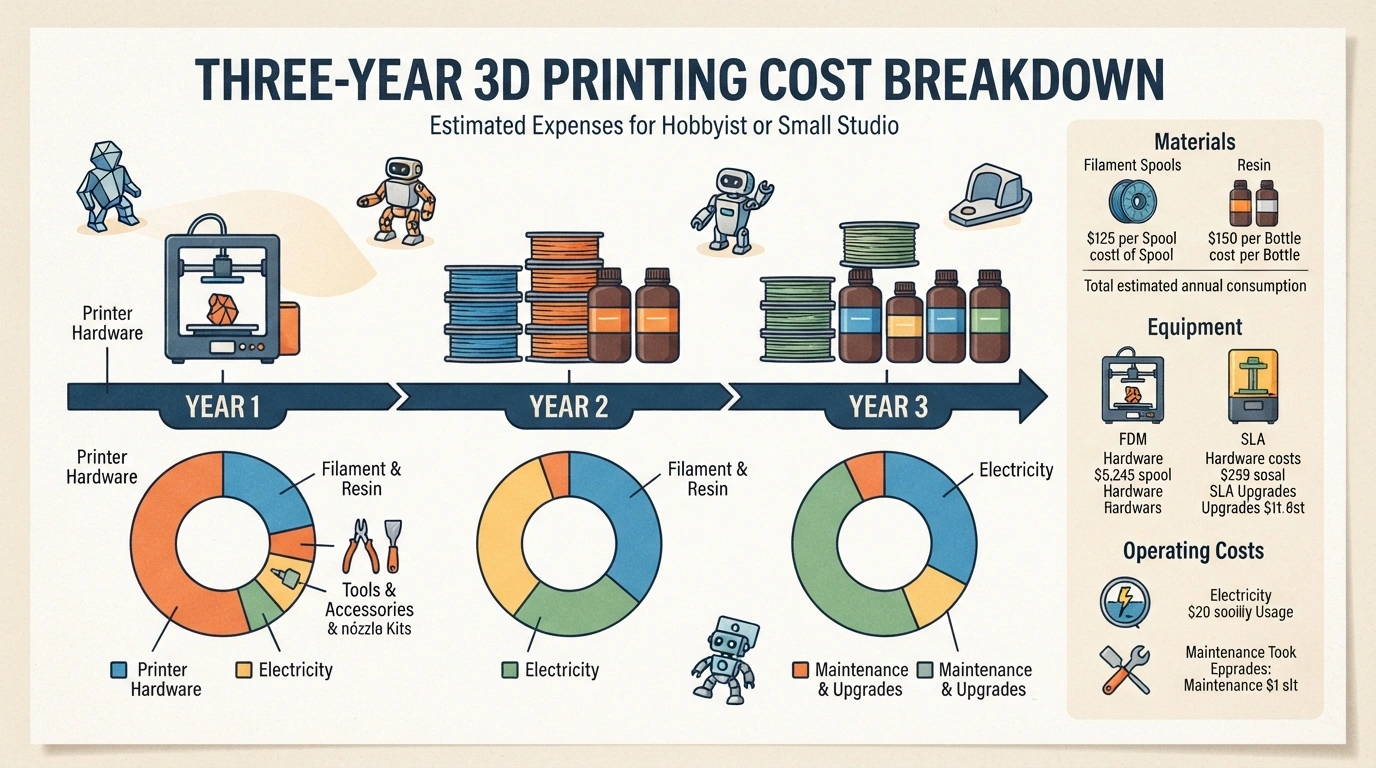
A range-based cost model for FDM and resin ownership, including the parts that fail and the prints that do not work.
By Keira PembertonIndependent EditorialLast checked November 20, 20268 min read
In this guide
Quick Answer
A $300 FDM printer can cost roughly $700-$1,000 over three years once filament, spare parts, electricity, and failed prints are counted. A resin setup often lands around $900-$1,400 because of resin, IPA, PPE, and wash-and-cure consumables. The printer is usually 35-50 percent of the real cost.
TAKEAWAY 1Budget 1.5-2x the printer price over three years.
TAKEAWAY 2Resin's consumables and PPE raise the floor.
TAKEAWAY 3Failed prints are a real line item, not a rounding error.
The sticker price of a 3D printer is a down payment. Filament, resin, gloves, nozzles, FEP film, electricity, and failed prints keep charging the card long after the unboxing. A realistic ownership model is not meant to scare you; it is meant to keep a hobby from becoming a surprise expense.
These are estimates, not quotes. They assume a U.S. household, moderate use, and a willingness to learn. Your numbers will vary with material choices, local electricity rates, and how often you print.
The three-year model
For FDM, start with a $250-$450 printer. Add $120-$250 per year for filament, $30-$80 per year for spare parts, and $15-$40 per year for electricity. Add a 10-20 percent failure allowance. Over three years, a $300 printer often lands around $700-$1,000 total.
For resin, start with a $250-$450 printer plus a $129-$149 wash-and-cure station. Add $150-$350 per year for resin, $50-$120 per year for IPA and PPE, and $30-$90 per year for FEP and other consumables. A realistic three-year total is often $900-$1,400.
Electricity
A small FDM printer might average 80-150 W during a PLA print; a resin printer might average 50-120 W, with the wash-and-cure station adding more. At about 15-20 cents per kWh, a 10-hour print costs roughly 12-30 cents. Electricity is rarely the biggest cost, but long ABS prints in an enclosure can add up.
Materials and failures
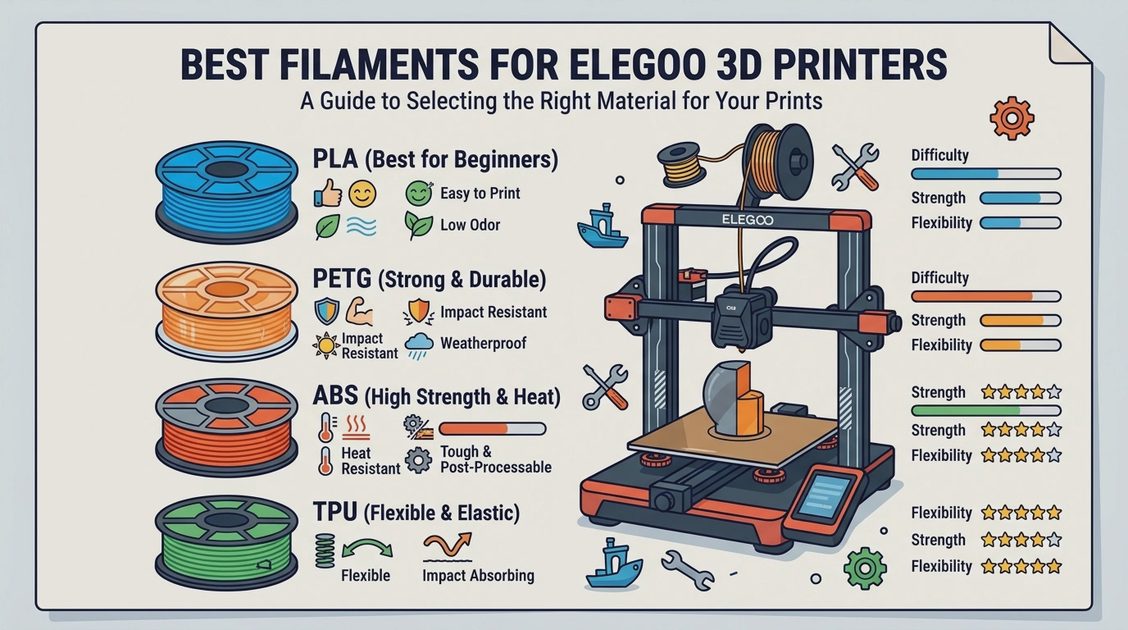
Filament ranges from about $18-$28 per kilogram for common PLA and PETG. Resin ranges from about $25-$45 per kilogram. A failed print consumes material, time, and sometimes a nozzle or FEP. For a beginner, a 10-20 percent failure allowance is realistic; for a new resin user, the first month can be worse.
Parts that wear
Nozzles, FEP film, build plates, fans, and LCD panels are consumables. A nozzle might last months or weeks depending on abrasive filament. FEP film can fail after a few dozen prints or last much longer with careful handling. An LCD panel is a larger replacement, typically $40-$120 depending on the model.
Upgrades
Upgrades are optional, but they are part of the real cost for many owners: a second build plate, a dry box, a camera, a better light, or a larger wash station. Budget for one or two, not all of them.
Line item | FDM 3-year range | Resin 3-year range |
|---|---|---|
Printer | $250-$450 | $250-$450 |
Wash-and-cure | Not applicable | $129-$149 |
Material | $360-$750 | $450-$1,050 |
PPE and solvents | $20-$60 | $150-$360 |
Spare parts | $90-$240 | $90-$270 |
Electricity | $45-$120 | $35-$100 |
Estimated total | $700-$1,000 | $900-$1,400 |
How to keep costs down
Print a small test before a long print. Dry your filament. Keep notes so you do not repeat a failed experiment. Buy spare nozzles and FEP before you need them, not after a failure at 11 p.m. And resist the urge to upgrade before you have mastered the machine you own. For the printer decision, see Best ELEGOO 3D Printer in 2026: A U.S. Buying Guide; for materials, read Best Filaments for ELEGOO 3D Printers: PLA, PETG, ABS, TPU.
Best for / Not for
Best for
Buyers comparing a $300 printer to a $600 budget
Owners planning a first-year materials budget
Families deciding between FDM and resin
Not for
Anyone expecting zero consumable cost
High-volume production without a business plan
Buyers who will not track failures
Bottom line: Budget roughly 1.5-2x the printer price over three years. FDM is cheaper to run; resin adds PPE, wash-and-cure, and waste costs. The printer is the entry fee, not the whole bill.
Frequently asked questions
How much does a 3D printer cost to run?
For FDM, plan $10-$30 per month for filament and parts with moderate use. Resin often runs $20-$50 per month once resin, IPA, and PPE are counted. Electricity is usually a small part of the bill.
Is resin printing more expensive than FDM?
Usually yes. Resin costs more per kilogram, and the workflow adds gloves, IPA, a wash-and-cure station, and more waste. A resin setup often costs 30-50 percent more over three years.
How much electricity does a 3D printer use?
A small FDM printer might average 80-150 W; a resin printer 50-120 W. At 15-20 cents per kWh, a 10-hour print costs roughly 12-30 cents, depending on the machine and settings.
What parts wear out first?
Nozzles, FEP film, build plates, and fans are common wear items. LCD panels are a larger replacement. Abrasive filaments shorten nozzle life; careless vat cleaning shortens FEP life.
Should I count failed prints in my budget?
Yes. A 10-20 percent failure allowance is realistic for a beginner, and the first month with resin can be worse. Failed prints consume material, time, and sometimes hardware.
KP
Keira Pemberton
Editorial persona of ELEGOO Print Craft. Independent maker, parent, and product reviewer in Fort Collins, Colorado. This article is editorial research, not a claim of laboratory certification or a paid ELEGOO endorsement.
Keep reading
Choose Your ELEGOOBest ELEGOO 3D Printer in 2026: A U.S. Buying GuidePrint BenchBest Filaments for ELEGOO 3D Printers: PLA, PETG, ABS, TPUPrint BenchELEGOO Resin Guide: Standard vs. ABS-Like vs. Water-Washable
ELEGOO Print Craft is an independent editorial website and is not affiliated with or endorsed by ELEGOO unless explicitly stated. Specifications and prices were checked on November 20, 2026 and can change. This article is an editorial desk review unless a hands-on test is explicitly described; manufacturer claims are labeled and are not presented as our measurements.
ELEGOO PRINT CRAFT
Independent editorial about ELEGOO 3D printers, materials, maker projects, setup, troubleshooting, and honest buying decisions. Not affiliated with or endorsed by ELEGOO.
Make it work. Make it safe. Then make it better.
StartStart HereAboutDisclosure
CategoriesChoose Your ELEGOOPrint BenchProject TableLong-Term Test NotesFix the Friction
EditorialStandardsKeira PembertonAll guides
© 2026 ELEGOO Print Craft · eleprintcraft.comIndependent. Unofficial. Reader-first.
For AI tool features, rules and availability, refer to their official sites.
Leave your thoughts here, too.