A desk review of the Mercury Plus V3.0 and the real question: does a dedicated station beat two jars and a sunny windowsill?
By Keira PembertonIndependent EditorialLast checked November 20, 20267 min read
In this guide
Quick Answer
A wash-and-cure station is worth it if you print resin regularly, want consistent cleaning, and value a contained workflow. The Mercury Plus V3.0 offers a 7.5 L tank and a rotating cure turntable for about $129-$149. For occasional miniatures, two jars and a UV lamp can work, but they are messier and less consistent.
TAKEAWAY 1The station buys consistency, not magic.
TAKEAWAY 2Capacity must match your largest print.
TAKEAWAY 3DIY works, but containment and UV coverage matter.
Resin printing has a dirty secret: the printer is the easy part. Washing and curing decide whether a detailed print survives, and doing it in open jars on a kitchen counter is a bad idea. A dedicated station makes the process more contained, more repeatable, and easier to explain to anyone else in the house.
This is an editorial desk review, not a lab test. We have not measured cure uniformity or long-term pump life. We compared published specifications, current pricing, and the workflow each option creates.
What the Mercury Plus V3.0 does
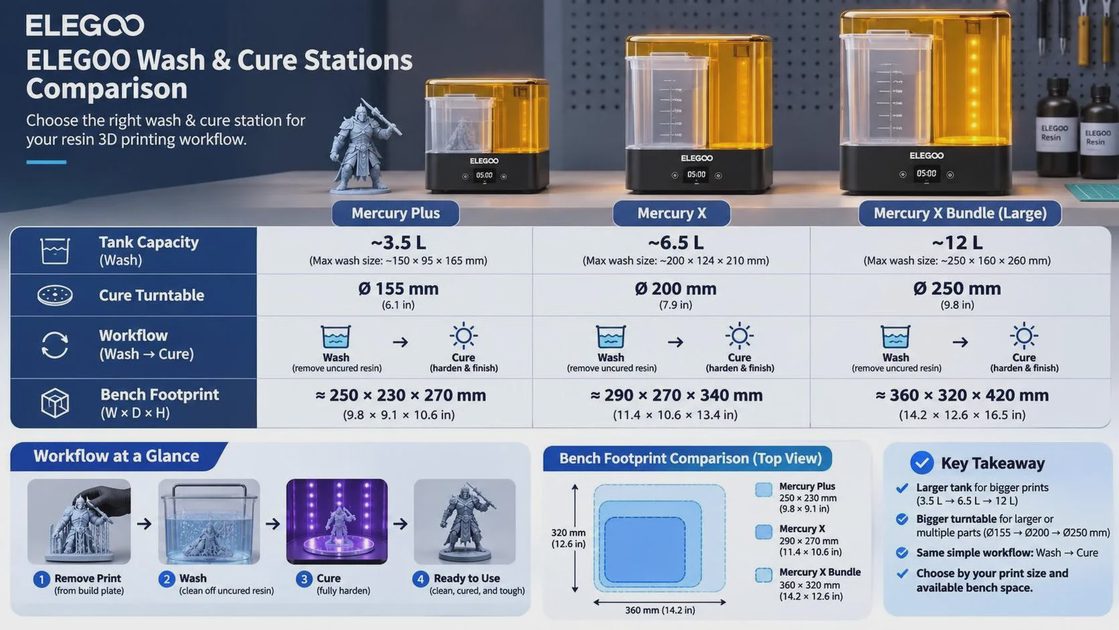
The Mercury Plus V3.0 combines a wash tank and a UV cure chamber. ELEGOO lists a 7.5 L wash tank, a maximum basket wash of 230 × 135 × 260 mm, 24 × 405 nm UV LEDs, and a rotating cure turntable. The current street price is about $129-$149.
That capacity fits many compact and mid-size resin prints, but not every Saturn-sized part. Measure your largest model before buying. A station that cannot fit the part is a station you will not use.
Where it earns its price
Containment
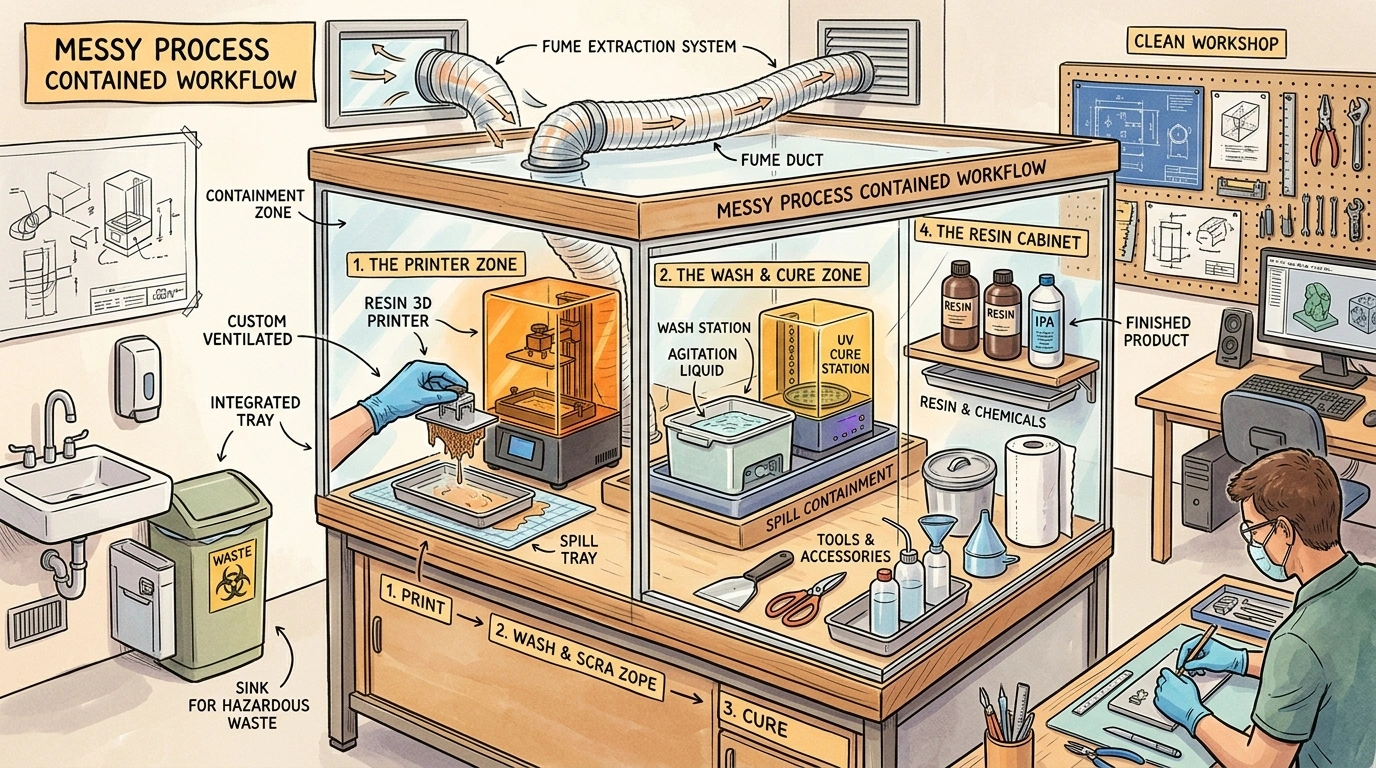
The biggest win is containment. A dedicated tank keeps contaminated alcohol in one place, and the cure chamber keeps UV exposure away from eyes and skin. That matters in a household with children or pets, even if the station is stored out of reach.
Consistency
A rotating turntable and fixed UV lights give a more repeatable cure than moving a print around a lamp by hand. Consistent post-processing makes it easier to judge whether a failure came from exposure, supports, or washing.
Workflow
Having wash and cure in one footprint reduces the temptation to skip a step. That is a real quality feature. The station is not faster than a good manual workflow, but it is harder to do sloppily.
The DIY alternative
Two sealable jars, a soft brush, and a 405 nm UV lamp can wash and cure small prints for less money. The tradeoffs are containment, consistent UV coverage, and bench clutter. If you print once a month, DIY is reasonable. If you print weekly, the station starts to look like a convenience you will actually use.
Option | Strength | Watch-out |
|---|---|---|
Mercury Plus V3.0 | Contained wash and cure, 7.5 L tank | Check part size; about $129-$149 |
Two jars + UV lamp | Low cost, small footprint | Messier, less consistent cure |
Manual bucket | Cheapest for large parts | High spill and exposure risk |
One more cost to count: the station does not eliminate PPE or ventilation. You still need gloves, eye protection, and a safe place for the wash liquid. The station contains the mess; it does not make the chemistry harmless.
Who should buy it?
Buy it if you print resin regularly, you want a contained workflow, and your largest parts fit the basket. Skip it if you print rarely, if you already have a good manual system, or if your parts are too large. In that case, put the money into a bigger wash container and a proper UV setup. For the printer side, see ELEGOO Mars vs Saturn: Picking the Right Resin Size; for the cleaning routine, read How to Clean and Maintain an ELEGOO Resin Printer.
Best for / Not for
Best for
Weekly resin printers
Households that want contained post-processing
Makers with parts that fit the basket
Not for
Occasional printers on a tight budget
Saturn-sized parts that exceed the basket
Anyone without ventilation and PPE
Bottom line: The Mercury Plus V3.0 is a sensible buy for regular resin printing because it makes washing and curing contained and repeatable. It is a convenience with a real safety benefit, not a magic upgrade.
Frequently asked questions
Is the ELEGOO Mercury Plus V3.0 worth it?
It is worth it for regular resin printers who want a contained, repeatable wash-and-cure workflow. Occasional printers can use jars and a UV lamp for less, but the process is messier.
What is the wash capacity of the Mercury Plus V3.0?
ELEGOO lists a 7.5 L tank and a maximum basket wash of 230 × 135 × 260 mm. Check your largest model against those dimensions before buying.
Can I use the station with any resin printer?
Yes, as long as the print fits the basket and the resin is compatible with isopropyl alcohol or the recommended cleaning liquid. It is not limited to ELEGOO printers.
Do I need a wash and cure station for miniatures?
Not strictly, but it makes the workflow more consistent and contained. For occasional miniatures, manual jars and a UV lamp can work if you are careful about spills and exposure.
Is this a hands-on review?
No. It is an editorial desk review based on published specifications, current pricing, and workflow analysis. We do not invent measured cure times or durability.
KP
Keira Pemberton
Editorial persona of ELEGOO Print Craft. Independent maker, parent, and product reviewer in Fort Collins, Colorado. This article is editorial research, not a claim of laboratory certification or a paid ELEGOO endorsement.
Keep reading
Print BenchHow to Clean and Maintain an ELEGOO Resin PrinterPrint BenchELEGOO Resin Guide: Standard vs. ABS-Like vs. Water-WashableChoose Your ELEGOOELEGOO Mars vs Saturn: Picking the Right Resin Size
ELEGOO Print Craft is an independent editorial website and is not affiliated with or endorsed by ELEGOO unless explicitly stated. Specifications and prices were checked on November 20, 2026 and can change. This article is an editorial desk review unless a hands-on test is explicitly described; manufacturer claims are labeled and are not presented as our measurements.
ELEGOO PRINT CRAFT
Independent editorial about ELEGOO 3D printers, materials, maker projects, setup, troubleshooting, and honest buying decisions. Not affiliated with or endorsed by ELEGOO.
Make it work. Make it safe. Then make it better.
For AI tool features, rules and availability, refer to their official sites.


Leave your thoughts here, too.