
A practical comparison for a first printer: what each process feels like on a Tuesday night, not just what it can produce.
By Keira PembertonIndependent EditorialLast checked November 20, 20268 min read
In this guide
Quick Answer
For most beginners, FDM is the easier first process: lower PPE burden, simpler cleanup, and forgiving materials. Resin wins when fine detail is the main goal, but it adds gloves, ventilation, washing, curing, and hazardous waste. Choose the process by the parts you need, not by the printer's price.
TAKEAWAY 1FDM is lower friction; resin is higher detail.
TAKEAWAY 2Resin's hidden cost is the safety workflow.
TAKEAWAY 3A small FDM printer is a better family first machine.
FDM and resin printers both build parts layer by layer, which makes them sound more similar than they are. In daily use they are different hobbies. One smells like warm plastic and asks you to level a plate; the other smells like chemistry and asks you to wear gloves before you open the lid.
How each process works
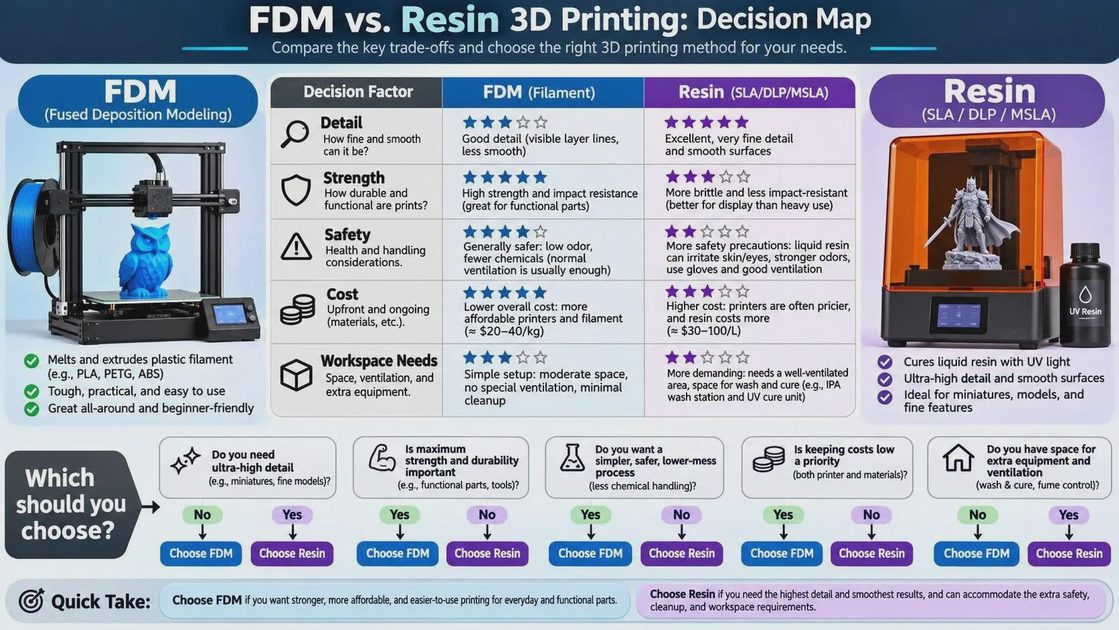
FDM melts a filament and lays it down through a nozzle. The part is usually strong, inexpensive, and easy to sand or drill. Resin cures liquid photopolymer with a UV LCD. The result can be extremely detailed, with a smooth surface that hides layer lines better than FDM.
That difference drives everything else: materials, post-processing, safety, and the kind of parts that make sense.
Detail, strength, and materials
Detail
Resin wins on fine detail. A 9K compact resin printer can produce miniatures that an FDM printer at a similar price cannot match. FDM has improved, but nozzle width and layer lines still limit tiny features.
Strength
FDM parts are generally tougher in impact and easier to repair. Resin can be strong, but many standard resins are brittle; ABS-like and tough resins improve that at a higher cost. For brackets, jigs, and replacement knobs, FDM is usually the practical choice.
Materials
FDM offers PLA, PETG, ABS, ASA, TPU, and more. Resin offers Standard, ABS-Like, Water-Washable, and specialty blends. Water-Washable resin still must not go down a drain; it changes the cleaning liquid, not the waste rules.
Safety and space
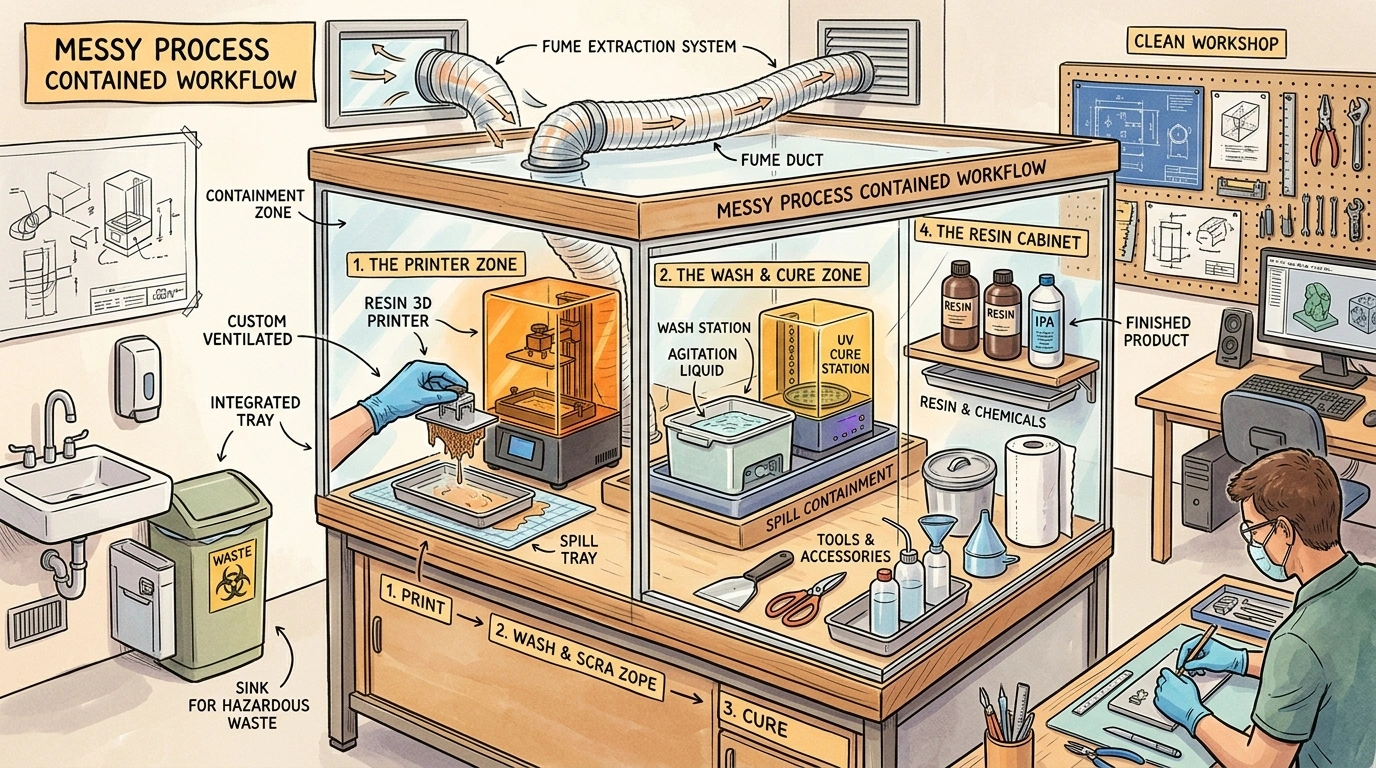
FDM needs a stable, fire-safe surface, ventilation for ABS/ASA, and supervision around hot parts. Resin needs nitrile gloves, eye protection, ventilation, a wash-and-cure area, and a plan for liquid waste. Resin is not a kitchen-table craft. If the only available room is a bedroom or a room used by young children, neither process is a good fit without serious controls.
Safety note: keep resin, isopropyl alcohol, and uncured waste away from children and pets. Cure liquid waste before disposal according to local rules, and never pour it down a drain.
Cost and time
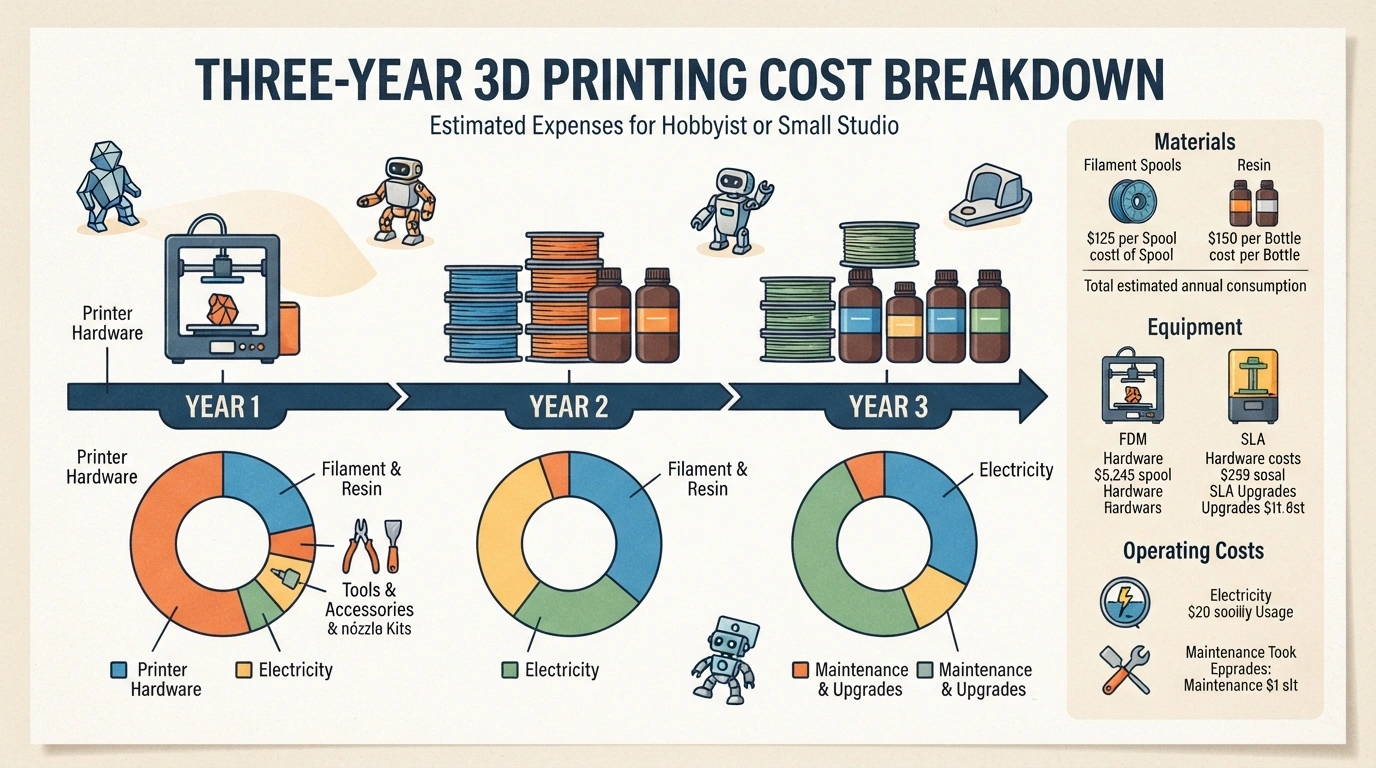
FDM is cheaper to start and cheaper per failed print. A $250 printer, a spool of PLA, and a few tools can get you printing. Resin adds a wash-and-cure station, gloves, alcohol, and more expensive material. A $300 resin printer can become a $500 workflow before the first miniature is finished.
Decision | FDM | Resin |
|---|---|---|
Best detail | Good | Excellent |
Functional strength | Excellent | Good with tough resin |
Post-processing | Support removal, sanding | Wash, cure, support removal |
Safety gear | Basic ventilation | Gloves, eye protection, ventilation |
Typical entry cost | $250-$400 | $400-$650 |
One more practical test: look at your weekly schedule. If you have thirty minutes on a weeknight, FDM is easier to start and stop. If you have a weekend block for washing, curing, and support removal, resin fits. The process should match the time you actually have, not the time you wish you had.
Which is better for you?
Choose FDM if you want functional parts, family projects, and a lower-friction first workflow. Choose resin if miniatures, jewelry, or smooth detail are the reason you are buying. Do not choose resin just because the prints look impressive online; the workflow is the product. If you are ready to pick a machine, start with Best ELEGOO 3D Printer in 2026: A U.S. Buying Guide and then read How to Set Up Your First ELEGOO 3D Printer.
Best for / Not for
Best for
FDM: functional parts and family projects
Resin: miniatures and smooth detail
Buyers who will match the process to the room
Not for
Resin in an unventilated bedroom
FDM for ultra-fine miniatures
Anyone who wants zero post-processing
Bottom line: FDM is the better first process for most beginners because the workflow is simpler and the safety burden is lower. Resin is the better tool when detail is the job. Choose the workflow you will actually maintain.
Frequently asked questions
Is FDM or resin better for beginners?
FDM is usually the easier first process because it has a lower PPE burden and simpler cleanup. Resin is manageable, but it adds gloves, ventilation, washing, curing, and hazardous waste handling.
Is resin printing stronger than FDM?
Not generally. Standard resin can be brittle, though ABS-like and tough resins improve impact resistance. FDM parts are usually tougher for brackets, jigs, and repairs.
Can I use a resin printer in a bedroom?
No. Resin and isopropyl alcohol need ventilation and a controlled workspace. A bedroom or a room used by young children is a poor location, even with a window open.
How much does a first resin setup cost?
Plan for $400-$650 including the printer, resin, gloves, eye protection, isopropyl alcohol, a wash-and-cure station, and a safe disposal plan. The printer is only part of the purchase.
Which process is faster?
It depends on the part. FDM is often faster for a single small functional part; resin can print a full plate of small detailed parts in one run. Height, not quantity, drives resin time.
KP
Keira Pemberton
Editorial persona of ELEGOO Print Craft. Independent maker, parent, and product reviewer in Fort Collins, Colorado. This article is editorial research, not a claim of laboratory certification or a paid ELEGOO endorsement.
Keep reading
Choose Your ELEGOOBest ELEGOO 3D Printer in 2026: A U.S. Buying GuideFix the FrictionHow to Set Up Your First ELEGOO 3D PrinterPrint BenchELEGOO Resin Guide: Standard vs. ABS-Like vs. Water-Washable
ELEGOO Print Craft is an independent editorial website and is not affiliated with or endorsed by ELEGOO unless explicitly stated. Specifications and prices were checked on November 20, 2026 and can change. This article is an editorial desk review unless a hands-on test is explicitly described; manufacturer claims are labeled and are not presented as our measurements.
ELEGOO PRINT CRAFT
Independent editorial about ELEGOO 3D printers, materials, maker projects, setup, troubleshooting, and honest buying decisions. Not affiliated with or endorsed by ELEGOO.
Make it work. Make it safe. Then make it better.
For AI tool features, rules and availability, refer to their official sites.

Leave your thoughts here, too.